I have written this article with the intention of explaining the basic concepts of Product Management in a simple and easy-to-understand way. The article is intended for readers who are new to Product Management or come from a non-PM background, while still being a valuable and enjoyable read for experienced professionals. 🙂
What is Product Management ?
Product Management is a core functional area in an organization. It is a process to guide the product from its ideation to launch and then to grow the product and support it till it is retired.
Who is a Product Manager?
A Product Manager is the persona who runs the product life cycle. Basically, the role of a Product Manager is to balance customer needs, business value, and technical feasibility to define the what and why of the product.
A Product Manager is a persona who typically follows below Product Management activities from start to end:
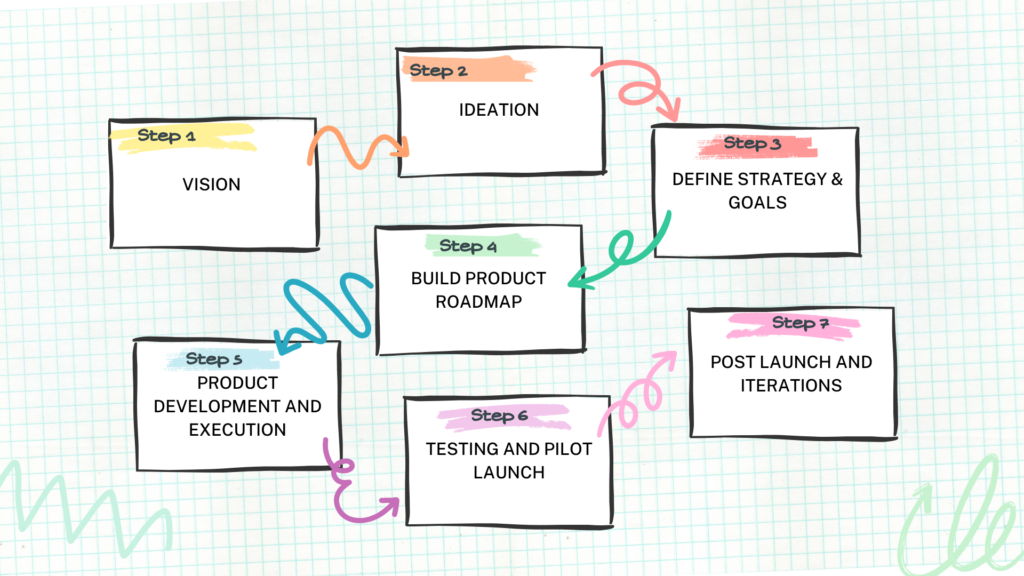
Vision
The very first thing a Product Manager would do is to define a vision (the “what” part). It is often termed as the “North Star,” which guides the organization towards what is intended to be achieved. The vision can be reviewed and readjusted after market research, competitive analysis during ideation phase.
Vision Example: “We want to build a digital wallet that makes cross-border payments faster and cheaper.”
Ideation
- Problem Identification
The first step a Product Manager takes is to carry out various activities to identify the right problem, pain points or need of having a product. This is usually carried out through
- Competitive Analysis – To analyse competitors’ offerings, identify gaps, and find opportunities that can be used to make the product better.
- Market Research – To understand growth opportunities , identify gaps in the market, better customer connection and to have advantage in the market.
- Customer feedbacks – take customer feedback of existing product to identify customer pain points.
Once all the ideas and inputs are available, the following steps are usually carried out:
- Brainstorming session – Various sessions are conducted with different stakeholders, such as brainstorming and mind-mapping sessions, to collaboratively generate and refine ideas.
- Idea Listing – All ideas discussed during these sessions are clearly listed and documented for further evaluation.
- Idea Screening – The listed ideas are evaluated against predefined criteria such as feasibility, business value, and customer impact to identify the most promising ideas.
- Idea Elaboration – The shortlisted ideas are elaborated and clearly explained to stakeholders and the target audience to ensure shared understanding and alignment.
Define Strategy and Goals
For a product to be successful, it is very important to have the right product strategy in place and well-defined KPIs to track progress.
- Break the vision into multiple smaller objectives that focus on different key focus areas of the strategy.
- For each objective, define the specific projects and actions required to achieve it.
- After this, decide the success metrics and KPIs that will measure the performance and impact of each objective.
Build Product Roadmap
Once the strategy is defined and metrics are in place, product features need to be created.
At this stage, high-level goals are defined and timelines are communicated to the development team so that everyone is aligned on what to build, when to build, and why it is being built.
The ideas shortlisted in the previous steps are evaluated against business objectives and then prioritized to ensure product success.
Product Development and execution
At this stage, all the features are well prioritized, and the detailed requirements need to be shared with the team. The Product Manager or Product Owner communicates these requirements to all stakeholders involved in the development phase.
These stakeholders usually include the engineering team—developers, QA, designers—and any other cross-functional teams that need to be involved in building the product.
Typically, Product Owners communicate these requirements to the teams during grooming (refinement) sessions. They work closely with the Scrum teams during sprints to ensure everyone is aligned, on track, and working toward achieving the goal while keeping the product vision in mind.
Testing and Pilot Launch
Post development and deployment, the newly launched product is initially tested in a restricted environment. Usually, after deployment, alpha testing is conducted by internal testing teams to validate the functionality of the product in the production environment. Once alpha testing is successful and passes all defined parameters, the product moves to the next stage.
The next step is usually the MVP launch. An MVP (Minimum Viable Product) is a launch of the basic core functionality of the product, covering the minimum required features so that the product can be released to users and real feedback can be collected.
Different organizations follow different Product Management approaches to product launches. In some cases, the MVP is launched in phases, where it is first released to a limited audience as part of a pilot launch. In this approach, a limited set of users gets access to the product with limited features. Based on market response, user adoption, and feedback, more features are gradually added. Eventually, the product is launched for a broader or global audience.
Post Launch and Iterations
In Product Management, a product is usually not launched in one go. As discussed earlier, it is launched in phases, and additional priority features are gradually added to the MVP. During this phase, the Product Manager continuously analyses the product performance, collects customer feedback, and identifies how enhancements and improvements can be made to the existing product.
Iterations can also be carried out even after the global launch of the product in order to improve the product and prolong its lifecycle. This phase is very important and can continue for many years. The main focus during this stage is to increase product adoption, improve customer experience, and drive customer acquisition.
The above-mentioned Product Management activities are usually carried out by the product team. However, it is not necessary that every Product Manager will follow all these activities exactly in the same way. In some organizations, a few steps may be combined, while in others, some additional activities may be included. This usually depends on the industry, the organization’s working model, and the type of product they are planning to launch.